
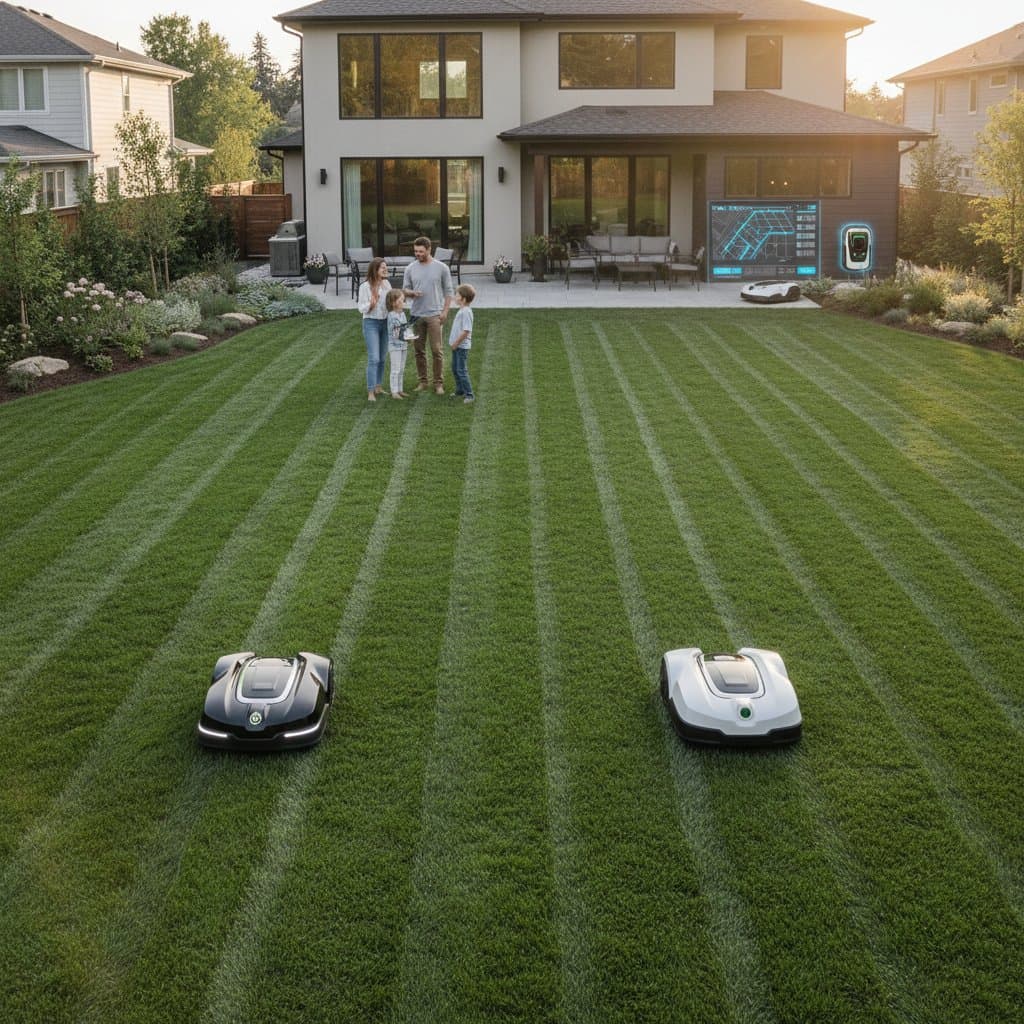
Robotic Mowers Manage Large Lawns Independently
The Peterson family transformed their extensive backyard during a renovation project. They sought relief from the demands of mowing more than 5,000 square feet of grass each weekend. Robotic mowers now provide that solution, operating quietly and independently to keep the lawn pristine.
These devices navigate the yard systematically, cutting grass in precise patterns. Homeowners gain time for other activities while the technology handles the routine. The result is a landscape that requires no direct oversight.
Advantages of Automated Lawn Care for Expansive Areas
Visitors to the Peterson property notice the impeccable condition of the grass immediately. The lawn appears freshly mowed daily, yet the equipment remains discreet. Robotic mowers move silently under trees and along boundaries, completing passes without disruption.
Lisa Peterson, a homeowner, shared her perspective: "We wanted something we could forget about. It had to handle our whole yard, not just a small patch, and it had to be reliable."
Reliability influences the entire system design, including perimeter wiring and charging station placement. Systems for larger areas prioritize endurance and intelligent navigation over basic models suited to smaller spaces.
Planning and Installation for Extensive Coverage
Managing over 5,000 square feet demands a multi-zone approach. The GreenEdge team segmented the Peterson yard into two areas, assigning a dedicated mower and base to each. The front section, with its open layout, uses the Husqvarna Automower 450X for efficient coverage.
The rear area, featuring trees and a play space, relies on the Worx Landroid L to maneuver obstacles. Separate perimeter wires define each zone, while a unified app enables monitoring and schedule adjustments. Users can pause operations for events or review performance data remotely.
Installation starts with a digital survey to assess slopes, beds, and paths. Teams bury the boundary wire two inches underground and verify signal integrity throughout. Calibration follows, typically completing the process in one afternoon.
Supporting Materials for Optimal Performance
The mowers perform core tasks, but complementary elements enhance their functionality. Careful selection of surfaces ensures smooth operation and aesthetic appeal.
- Perimeter edging: Concrete pavers installed flush with the grass to guide boundaries.
- Pathways: Permeable gravel surfaces that support wheel traction and drainage.
- Charging pads: Crushed granite bases reinforced with metal edging for stability.
- Planting beds: Pine bark mulch to clearly delineate edges and minimize clipping scatter.
These choices prevent snags on irregularities and maintain mower mobility across varied terrain. Functionality aligns seamlessly with visual harmony.
Routine Upkeep for Long-Term Reliability
Robotic mowers demand little maintenance, yet consistent checks preserve efficiency. The Petersons adhere to guidelines from their installers for straightforward care.
- Clean components weekly with a soft brush to clear grass residue from blades and wheels.
- Examine blades monthly and replace them every few months if sharpness diminishes.
- Verify boundary wire integrity if the mower halts unexpectedly, addressing any breaks.
- Store units indoors during winter, maintaining batteries at half charge to protect longevity.
Lisa Peterson noted, "It’s less work than cleaning a coffee maker. Once you get used to it, you forget it’s even happening."
Benefits of Reduced Noise in Daily Life
Noise levels represent a significant improvement over conventional equipment. Traditional mowers generate considerable sound, whereas robotic models produce only a gentle hum. The Peterson family converses on the patio or dines al fresco without interruption.
Children enjoy the yard barefoot, free from debris risks. The uniform cut height integrates clippings back into the soil, fostering healthier growth. Daily access to a well-kept space encourages more outdoor time.
Integrating Technology into Landscape Routine
Months into operation, the Petersons highlight unwavering consistency as the primary advantage. The system adapts to weather variations and growth rates automatically. Weekends free from mowing allow greater focus on leisure.
For properties with substantial acreage, robotic mowers eliminate manual efforts entirely. Success depends on precise zoning, terrain-appropriate models, and expert configuration. Installers such as GreenEdge observe that configured systems operate autonomously thereafter.
Advancements in sensors and battery life continue to expand capabilities, making larger lawns more accessible to automation.
Steps to Implement Automated Mowing
Transitioning to robotic care elevates the yard from obligation to asset. The Petersons' design incorporates strategic charger locations and seamless zone transitions. This approach maximizes usability and minimizes issues.
Prospective users should evaluate lawn dimensions, inclines, and activity patterns first. Select mowers compatible with specific features, and engage professionals for installation. Such preparation yields a dependable, low-effort outcome.
The Petersons demonstrate the potential of blending innovation with practical design. Their landscape achieves tidiness through automation, delivering the convenience that enhances everyday living.