
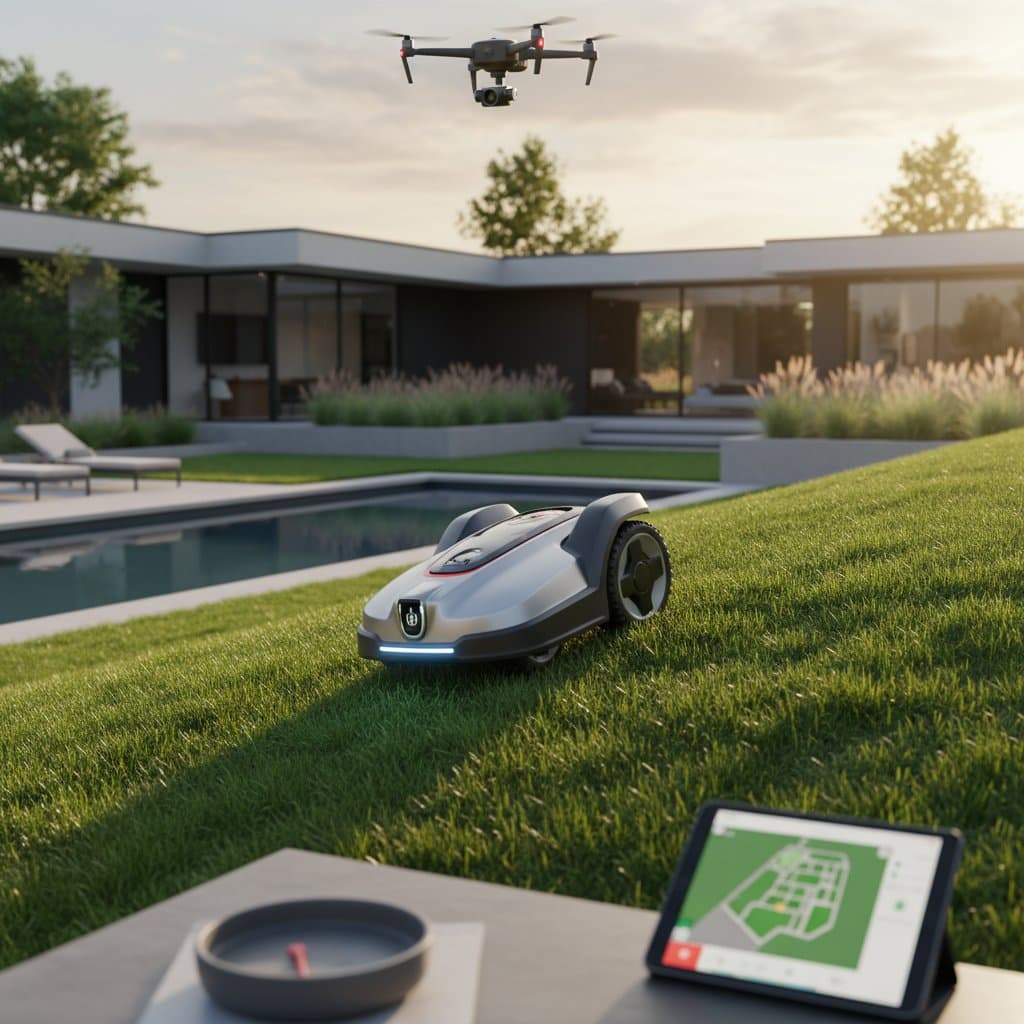
Advanced Robotic Mowers Tackle Challenging Landscapes
Homeowners previously viewed robotic lawn mowers as suitable only for flat, uniform yards. Recent advancements have expanded their capabilities significantly. These machines now navigate slopes, roots, and irregular surfaces with remarkable accuracy, bringing automation to lawns that once demanded intensive manual labor.
The primary advantage lies in their ability to maintain even grass growth without frequent human intervention. Owners reclaim valuable time while achieving a professional, manicured appearance across their property.
Mastering Steep Slopes and Uneven Terrain
Earlier models of robotic mowers faced limitations on inclines, often losing grip on slopes beyond mild gradients. Contemporary designs incorporate robust wheel motors, responsive sensors, and gyroscopic stabilization systems. Such features enable these mowers to ascend grades reaching 35 to 40 percent, varying by specific model.
A landscape contractor observes, "Clients with hillside properties once ruled out robotic mowing options. Now, installations on steep terrains proceed confidently."
This performance proves essential for yards where conventional mowing poses physical risks or excessive effort. Variable speed adjustments ensure steady progress, preventing slips or wheel spin on challenging surfaces.
Key Benefit: Manages inclined or irregular lawns independently.
Practical Tip: Select models with treads and torque suited to the site's gradient.
Model Example: The Husqvarna Automower 435X AWD employs four-wheel drive and articulated steering to traverse sloped gardens, avoiding soil compaction or damage to the turf.
Navigating Obstacles and Roots Effectively
Beyond slopes, modern robotic mowers excel at detecting and circumventing obstacles such as tree roots, rocks, and garden edges. Integrated ultrasonic and infrared sensors provide real-time environmental awareness, allowing the machine to alter its course smoothly.
This obstacle avoidance reduces the need for pre-mowing yard preparation. The mower pauses briefly if needed, then resumes its pattern, ensuring comprehensive coverage without user adjustments.
Key Benefit: Preserves lawn integrity while covering complex layouts.
Practical Tip: Position sensors away from debris-prone zones during initial setup.
Model Example: Units equipped with bump-and-lift technology, like certain Segway models, gently elevate over low roots, maintaining a clean cut without stalling.
Adaptive Cutting for Diverse Grass Conditions
Different grass varieties and soil types demand varied maintenance approaches. Intelligent mowers assess resistance from the turf and modify blade height and speed accordingly. On dense or moist areas, they reduce pace and raise the blade slightly to prevent uneven scalping.
A turf specialist notes, "Adaptive features ensure each mowing session optimizes efficiency. The device recognizes demands and allocates energy wisely."
Such adjustments promote uniform lawn health across mixed environments. They also mitigate stress on the grass, fostering stronger root development.
Key Benefit: Sustains turf vitality amid changing conditions.
Practical Tip: Set height ranges by zone; taller cuts suit shaded cool-season grasses, while shorter ones fit sunny exposures.
Model Example: Advanced systems automatically adjust from three inches on shaded fescue to two inches in sunlit front yards, eliminating manual reconfiguration.
Advanced Mapping and Virtual Boundaries
Traditional boundary wires limited flexibility in robotic mower deployment. Current models leverage GPS and onboard cameras to establish virtual boundaries and operational zones via a companion app. Users redefine perimeters digitally, avoiding physical alterations to the yard.
A landscape designer comments, "This adaptability accommodates garden redesigns without halting mowing routines."
Virtual zoning further refines care by assigning tailored schedules to specific areas. High-visibility front lawns receive frequent trims, whereas back areas get periodic maintenance.
Key Benefit: Eases installation and adapts to landscape changes.
Practical Tip: Pair digital maps with physical markers in busy zones for enhanced accuracy.
Model Example: After adding a patio or new beds, app updates redirect the mower instantly, integrating the changes seamlessly.
Seamless Connectivity and Remote Oversight
Mobile app integration elevates user control over robotic mowers. Owners track real-time status, modify schedules, and pinpoint the device's location remotely. Compatibility with smart home systems enables voice-activated commands for added convenience.
A consultant remarks, "Monitoring from afar builds user assurance. Live feeds confirm the mower operates as intended."
Geofencing features enhance security by notifying users of unauthorized movement. Firmware updates via the app keep navigation and efficiency algorithms current.
Key Benefit: Streamlines oversight and bolsters anti-theft measures.
Practical Tip: Activate boundary alerts to monitor deviations promptly.
Model Example: Upon detecting exit from the designated area, the app issues notifications and secures the unit until retrieval.
Establishing a Routine with Robotic Mowing
Integrating a robotic mower into daily life shifts the focus from device management to effortless garden upkeep. Initial configuration of docking stations, zones, and paths aligns the system with the property's contours and inclines. From there, it operates discreetly, delivering consistent trims that support optimal grass health.
Regular checks on battery levels and sensor cleanliness ensure sustained performance. Over time, this technology cultivates yards that thrive with minimal input, enhancing outdoor enjoyment year-round.