
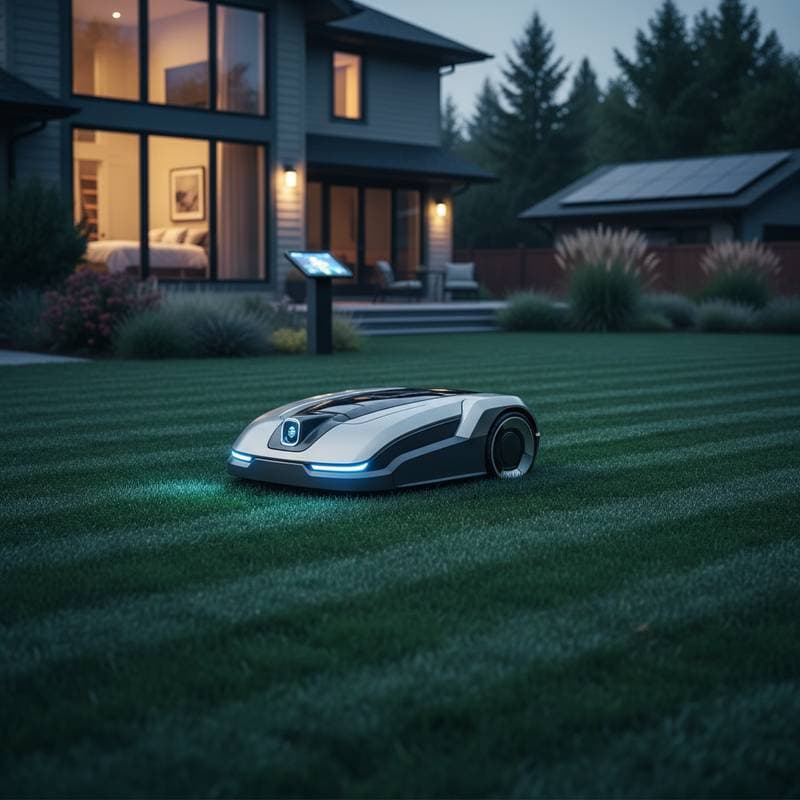
Robotic Mowers: Effortless Lawn Maintenance While You Rest
A pristine lawn enhances the appeal of any home. For numerous homeowners, however, the task of mowing grass ranks among the least favored chores. Robotic mowers alter this dynamic entirely. These innovative devices operate autonomously, tending to the yard during off-hours and delivering a uniformly manicured appearance each day.
The primary advantage stems from their capacity for ongoing maintenance with negligible human involvement. Equipped with advanced sensors, navigation algorithms, and environmental monitoring, these machines sustain optimal grass length. Homeowners benefit from a vibrant lawn and additional leisure time, shifting focus from labor to enjoyment.
Establishing Effective Boundaries for Optimal Performance
Successful operation of a robotic mower begins with precise boundary definition. Most units rely on a perimeter wire installed underground or utilize satellite-based positioning to delineate the mowing zone. Landscape professionals often compare this initial configuration to sketching a blueprint for the yard, guiding the device around obstacles and ensuring comprehensive coverage.
In properties featuring intricate layouts, such as multiple tiers or irregular borders, dividing the area into distinct zones proves essential. The mower learns these routes through repeated cycles, refining its path to eliminate gaps and achieve even results. Proper planning minimizes the risk of overgrowth in secluded spots and safeguards delicate features like flower beds.
Key advantage: Uniform mowing patterns that require no manual adjustments.
Practical recommendation: Combine perimeter wires with durable edging options, such as metal strips or natural stone, to provide a reliable guide for the machine.
Visual tip: Low-profile metal edging establishes clear boundaries and directs the mower efficiently.
Selecting the Right Model for Your Yard
Choosing an appropriate robotic mower involves assessing yard size, terrain, and desired features. Entry-level models suit small, flat lawns up to 1,000 square feet, while advanced units handle larger areas exceeding 10,000 square feet, including slopes up to 45 degrees. Evaluate battery life, cutting width, and obstacle avoidance capabilities to match your specific needs.
Consider integration potential as well. Premium models offer app-based controls for scheduling, height adjustments, and performance monitoring. Brands like Husqvarna or Worx provide options with anti-theft features, such as GPS tracking and PIN codes, adding security for unattended operation.
Key advantage: Tailored performance that aligns with yard dimensions and user preferences.
Practical recommendation: Test compatibility with existing smart home devices during selection to ensure seamless connectivity.
Promoting Turf Vitality with Incremental Trimming
Conventional mowing practices frequently involve removing excessive grass in a single session, which can weaken the turf. Robotic mowers adopt a superior strategy by performing frequent, shallow cuts. This method fosters thicker growth and bolsters resilience against environmental stresses.
The resulting clippings decompose naturally, acting as organic fertilizer that enriches the soil. Such mulching reduces reliance on chemical inputs and minimizes thatch accumulation. Experts in horticulture note that these consistent trims emulate natural processes, yielding a verdant, uniform lawn.
Key advantage: Enhanced soil nutrition and reduced buildup of organic debris.
Practical recommendation: Use the companion application to fine-tune blade height in gradual steps, adapting to variations in seasonal growth rates.
Ensuring Safety and Reliability in Daily Use
Safety features distinguish high-quality robotic mowers from basic models. Built-in sensors detect objects, lift the blades during collisions, and trigger automatic shutdowns if tampered with. Many include rain detection to return to the charging station, preventing damage from wet conditions.
Regular maintenance sustains long-term efficiency. Clean the undercarriage weekly to remove debris, and inspect blades monthly for sharpness. Scheduling software allows customization, such as avoiding peak hours to minimize noise disturbance.
Key advantage: Secure, dependable operation that protects both the device and the landscape.
Practical recommendation: Position the charging dock in a shaded, accessible spot to optimize battery performance and ease of access.
Connecting with Smart Landscape Ecosystems
Robotic mowers enhance their utility when incorporated into broader automated systems. Compatibility with irrigation timers, soil moisture probes, and smart hubs enables synchronized actions. For instance, upon sensing precipitation, the mower halts to avoid soil compaction and resumes once conditions improve.
This interconnected approach optimizes resource use. Coordinated watering and mowing maintain ideal hydration levels, promoting deeper roots and drought resistance. Professionals in landscape management emphasize that such synergy achieves equilibrium, preserving turf quality without excessive intervention.
Key advantage: Efficient coordination that minimizes turf stress and conserves water.
Practical recommendation: Employ a robust, encrypted Wi-Fi network to facilitate reliable data exchange between all connected components.
Adapting the Yard Design for Seamless Automation
To maximize the effectiveness of robotic mowing, the yard layout must accommodate the machine's movements. Opt for gradual inclines, ample turning radii, and unobstructed grassy expanses. Steer clear of abrupt edges or thick barriers that could impede navigation.
Strategic planting complements this setup. Select low-growing varieties, such as sedum or vinca, along perimeters to add visual interest without obstructing paths. Designers advocate for streamlined configurations, where fluid contours aid the mower's algorithms in plotting efficient routes.
Key advantage: Uninterrupted functionality that lowers overall upkeep demands.
Practical recommendation: Incorporate sweeping lawn curves to simplify pathfinding and enhance aesthetic flow.
Embracing the Benefits of Automated Turf Care
With proper implementation, robotic mowing integrates smoothly into daily routines. The yard remains impeccably groomed, operations proceed discreetly, and weekends open up for relaxation rather than toil. The subtle operation of these devices harmonizes with the cadence of modern living.
This technology merges accuracy with convenience, fostering sustainable lawns and streamlined home management. To begin, map your boundaries, select a compatible model, and establish a nocturnal schedule. The mower assumes responsibility thereafter, delivering precision through each methodical traversal.