
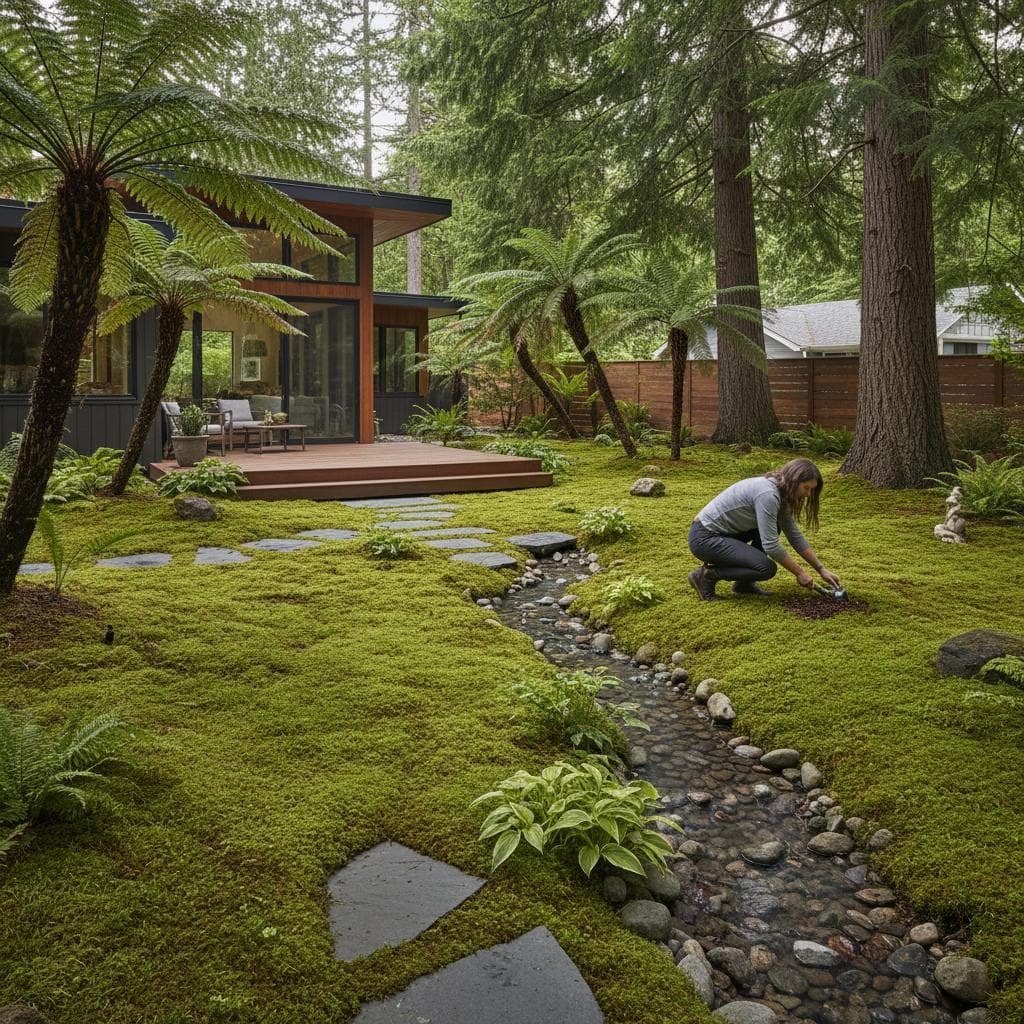
The 60% Rise of Moss Lawns: A Sustainable Shift from Traditional Turf
Moss lawns gain ground in landscapes where grass often fails. They provide a dense, vibrant covering that requires far less water and eliminates the need for mowing. As homeowners and designers embrace this option, moss delivers a tranquil aesthetic with effortless care.
Key Considerations at a Glance
- Ideal Locations: Shaded yards or areas with mixed sunlight exposure
- Scalability: Suitable for small patios or expansive lawn replacements
- Best Climates: Temperate zones with humidity or consistent moisture
- Primary Benefits: Reduced water use, no mowing, and enhanced ecological harmony
1. Select Moss Species Matched to Your Site
Choose moss varieties that align with your yard's specific conditions to ensure long-term success. For deep shade under trees or on north-facing inclines, opt for Hypnum imponens or Thuidium delicatulum, both of which form spreading mats over time. In areas with partial sun, Bryum caespiticium tolerates brighter light and brief dry periods while maintaining its cushion-like form.
A landscape designer notes: "Aligning moss types with local microclimates promotes vigorous growth without added irrigation or nutrients." Moss plants draw moisture directly through their leaves, allowing them to establish on shallow or compacted soils. Incorporating a blend of species introduces gentle variations in hue and form, evoking the layered beauty of forest floors.
Highlighted Feature: Soft emerald expanses of Hypnum moss weave seamlessly between garden stepping stones.
2. Prepare the Site for Optimal Attachment
Establish a stable foundation by clearing the area of weeds, rocks, and loose material, then compact the soil lightly with a roller or tamper. Moss prefers acidic environments, so measure the soil pH and amend it to around 5.0 using elemental sulfur or sphagnum peat moss if the reading exceeds 6.0.
A landscape contractor explains: "A solid, acidic base allows moss to adhere firmly and expand uniformly." Steer clear of chemical fertilizers or lime applications, as these disrupt moss development. During the initial two to four weeks, apply a fine mist daily to encourage rooting, particularly in regions with low ambient humidity.
Highlighted Feature: Use a handheld sprayer to maintain moisture on transplanted moss sheets in the early stages.
3. Design for Texture and Natural Flow
Moss forms a plush, walkable surface that contrasts with the uniformity of grass lawns. Integrate multiple species along walkways, beneath evergreens, or encircling natural features like rocks to build visual depth. This approach fosters an organic feel that encourages barefoot exploration and contemplation.
A garden designer observes: "Moss adds dimension to outdoor spaces by reflecting light in evolving patterns throughout the day." Complement it with companion plants such as shade-tolerant ferns, hostas, or low-growing native grasses to sustain interest without increasing water demands.
Highlighted Feature: Cushioned moss mounds transition smoothly into delicate sedge fronds bordering a gravel path.
4. Harness and Direct Available Moisture
Moss excels in moist settings yet adapts to intermittent dryness when protected from direct sun. Channel excess water from gutters or gentle slopes toward moss zones using subtle grading or permeable barriers. Create shallow contours or micro-basins in the surface to capture and retain dew or light rainfall.
A horticulturist advises: "Moss relies on atmospheric humidity rather than deep watering, so strategic placement suffices over mechanical systems." In drier climates, introduce a brief morning mist two to three times weekly to preserve vitality and prevent browning.
Highlighted Feature: Subtle stone edging directs seasonal runoff to nourish the moss without pooling.
5. Implement Effortless Upkeep Routines
Once rooted, moss demands little intervention, freeing time from routine lawn tasks. Skip fertilizers entirely, and limit weeding to occasional removal of invasive seedlings. Sweep away accumulated leaves or branches gently with a soft-bristled broom to avoid blocking sunlight.
A groundskeeper shares: "Moss thrives on minimal intervention, yielding substantial reductions in water and equipment use." To revive sparse areas, harvest small clippings from dense sections, press them into the soil, and mist until they take hold, typically within one season.
Highlighted Feature: A flexible broom clears surface litter while preserving the moss's delicate structure.
Embracing the Everyday Benefits of Moss
Adopting a moss lawn alters the sensory experience of your outdoor environment. The persistent greenery endures through arid periods, and the absence of mechanical noise fosters a more peaceful routine. This choice aligns with broader preferences for landscapes that demand less effort while enhancing biodiversity.
Homeowners enjoy simplified care and a forgiving surface for challenging light conditions. Designers discover versatile solutions for tricky terrains. Ultimately, moss lawns embody an efficient path to resilient, harmonious gardens that honor natural processes.