
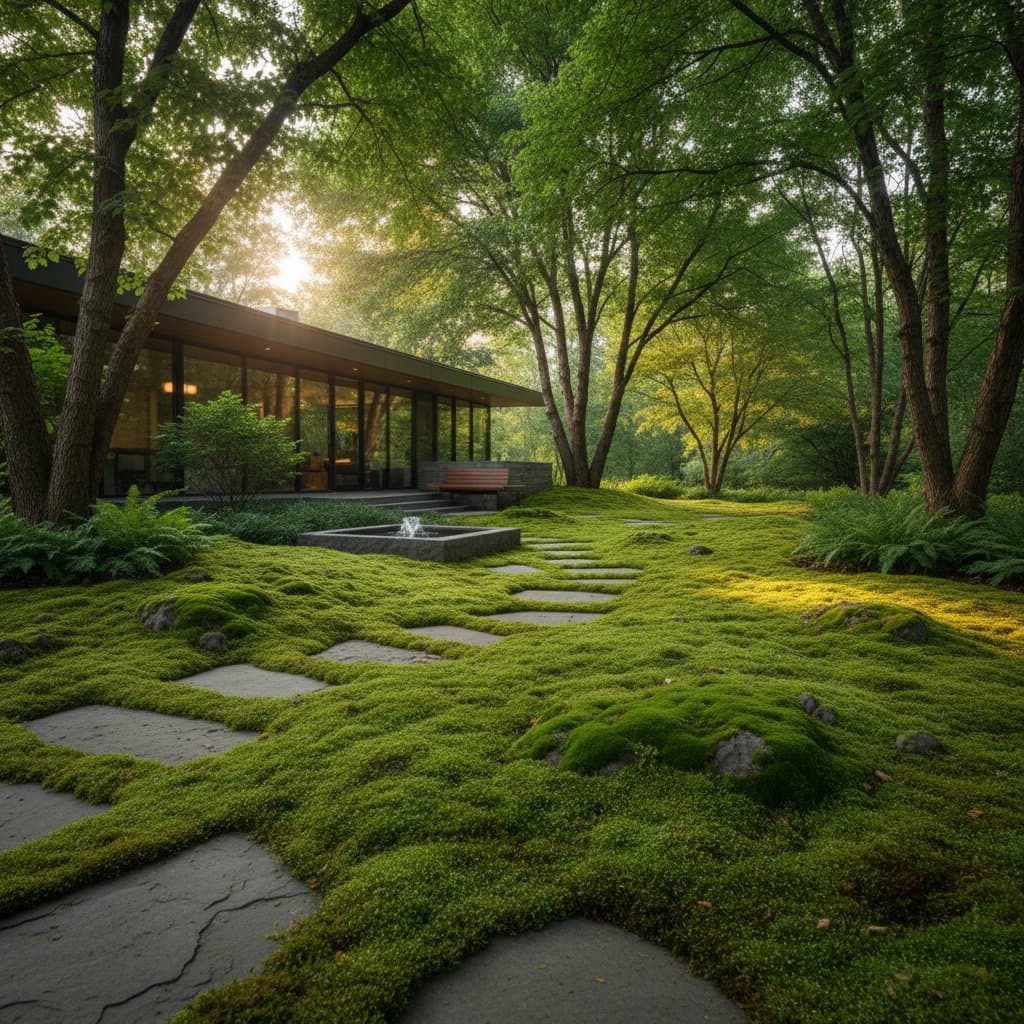
Moss Lawns: The No-Mow Revolution for Yards in 2026
Soft underfoot and green throughout the year, moss lawns reshape traditional front and backyards. Their quiet beauty and minimal maintenance offer homeowners relief from weekly grass cutting. These lawns thrive in shaded or damp areas where turf often struggles, transforming such spaces into lush, calming landscapes.
At a Glance
Location: Temperate or shaded climates
Size: Suitable for small courtyards or large natural lots
Climate Zone: Prefers cool, moist conditions, though adaptable species suit drier zones
Project Goal: Minimize maintenance and water use while enhancing visual calm
1. Start with the Right Conditions
Moss flourishes in specific environments but spreads naturally once established. It requires shade, consistent moisture, and slightly acidic soil with a pH between 5.0 and 6.0. Landscape professionals note that moss succeeds precisely where grass cannot.
Functional Benefit: Ideal for areas under trees or near north-facing walls where turf fails.
Design Insight: Select species such as Hypnum cupressiforme for dense shaded coverage or Racomitrium canescens for moderately dry conditions.
Example: Transform a wooded backyard with sparse grass into a uniform moss carpet that requires no mowing.
Prepare the site by clearing debris and weeds, then lightly rake the soil surface to create texture for adhesion. Introduce moss by transplanting fragments or laying sheets directly onto the prepared ground. Maintain damp conditions for the first few weeks to promote rooting; afterward, natural rainfall suffices for vitality.
2. Skip the Mower, Keep the Calm
The primary advantage of moss lawns lies in eliminating the need for mowing. Moss maintains a low, even height naturally, preserving a sculpted appearance across uneven terrain like slopes or gentle curves.
Functional Benefit: Eliminates noise pollution, fuel consumption, and labor associated with yard maintenance.
Design Insight: The uniform surface of moss accentuates adjacent plants, stone elements, and water features.
Example: In a courtyard surrounded by ferns and stepping stones, moss provides a serene, consistent ground plane.
A landscape architect observes, "The quiet of a moss lawn alters the experience of a space. It invites a slower pace." This absence of mechanical intervention turns the yard into a haven for relaxation rather than routine tasks.
3. Design with Contrast and Texture
Moss integrates seamlessly with natural materials, softening hard edges and harmonizing with organic forms. Thoughtful contrasts ensure the moss appears as a deliberate design choice rather than an oversight.
Functional Benefit: Stabilizes soil on inclines while drawing attention to architectural and planting elements.
Design Insight: Pair moss with flagstone pathways, gravel edging, or low-growing native shrubs to delineate boundaries.
Example: A flagstone path winding toward outdoor seating, edged by moss and sedges, creates a grounded, flowing composition.
Designers emphasize, "A modest moss installation suffices to influence the atmosphere. A few square feet near an entry or patio can connect the home to the garden visually."
4. Manage Moisture Wisely
Moss absorbs moisture from the air and light precipitation, yet it avoids areas prone to pooling water. Established moss requires infrequent supplemental watering, relying primarily on ambient humidity.
Functional Benefit: Demands far less water than traditional turf, promoting resource conservation.
Design Insight: Incorporate subtle irrigation like drip lines or mist systems during extended dry periods.
Example: A shaded nook previously reliant on daily sprinklers now sustains itself with rainfall and dew alone.
Protect the moss by limiting foot traffic during wet conditions to prevent compaction. Install stepping stones or gravel paths to direct movement and preserve the delicate surface.
5. Keep It Clean, Not Complicated
Moss maintenance involves straightforward practices to sustain health without excess effort. Remove fallen leaves and debris regularly to allow light and air circulation; avoid chemical interventions that could damage the plants.
Functional Benefit: Fosters biodiversity through minimal disturbance.
Design Insight: Employ a soft-bristled broom or low-powered leaf blower to clear surfaces gently.
Example: An entry garden under shade trees remains pristine with biweekly sweeping, retaining its velvety texture.
A horticulturist advises, "Moss responds well to minimal intervention. The lighter the touch, the stronger its growth."
6. Encourage Natural Spread
Established moss propagates effortlessly through fragments dispersed by weather or wildlife. Homeowners can accelerate coverage by relocating small clumps to sparse areas or applying light mist to stimulate activity.
Functional Benefit: Achieves expansion without the need for seeding or extensive replanting.
Design Insight: Mix species like Dicranum scoparium for cushion-like form with Leucobryum glaucum for subtle variation in texture.
Example: On a backyard slope, intermingled patches of these mosses form a dynamic, layered ground cover.
This natural progression appeals to those who value gardens that evolve over time. Moss adapts to shifting light and moisture, delivering persistent green hues across seasons.
7. Pair Moss with Sustainable Features
Moss lawns align with eco-conscious landscaping by acting as living mulch and enhancing soil retention. They create habitats for insects and integrate with elements like rain gardens or permeable surfaces.
Functional Benefit: Mitigates stormwater runoff and bolsters overall soil integrity.
Design Insight: Position moss adjacent to rain chains, retention basins, or eco-patios for fluid transitions.
Example: A rain garden edged with moss and river rocks manages water flow while merging into the broader landscape.
One designer remarks, "Moss bridges the gap between constructed and wild elements. It fosters a balanced, restorative outdoor environment."
Sustaining the Serenity of Moss
Adopting a moss lawn often transforms how homeowners interact with their outdoor spaces. Freed from mowing and fertilizing, these areas encourage leisurely enjoyment. The cool, resilient texture underfoot pairs with enduring color, weaving moss into the fabric of trees, rocks, and paths.
Preserve vitality by ensuring occasional moisture and seasonal debris removal. Address any compacted areas with fresh transplants as needed. Ultimately, moss delivers a tranquil, adaptive surface that embodies simplified, enduring beauty in modern yards.