
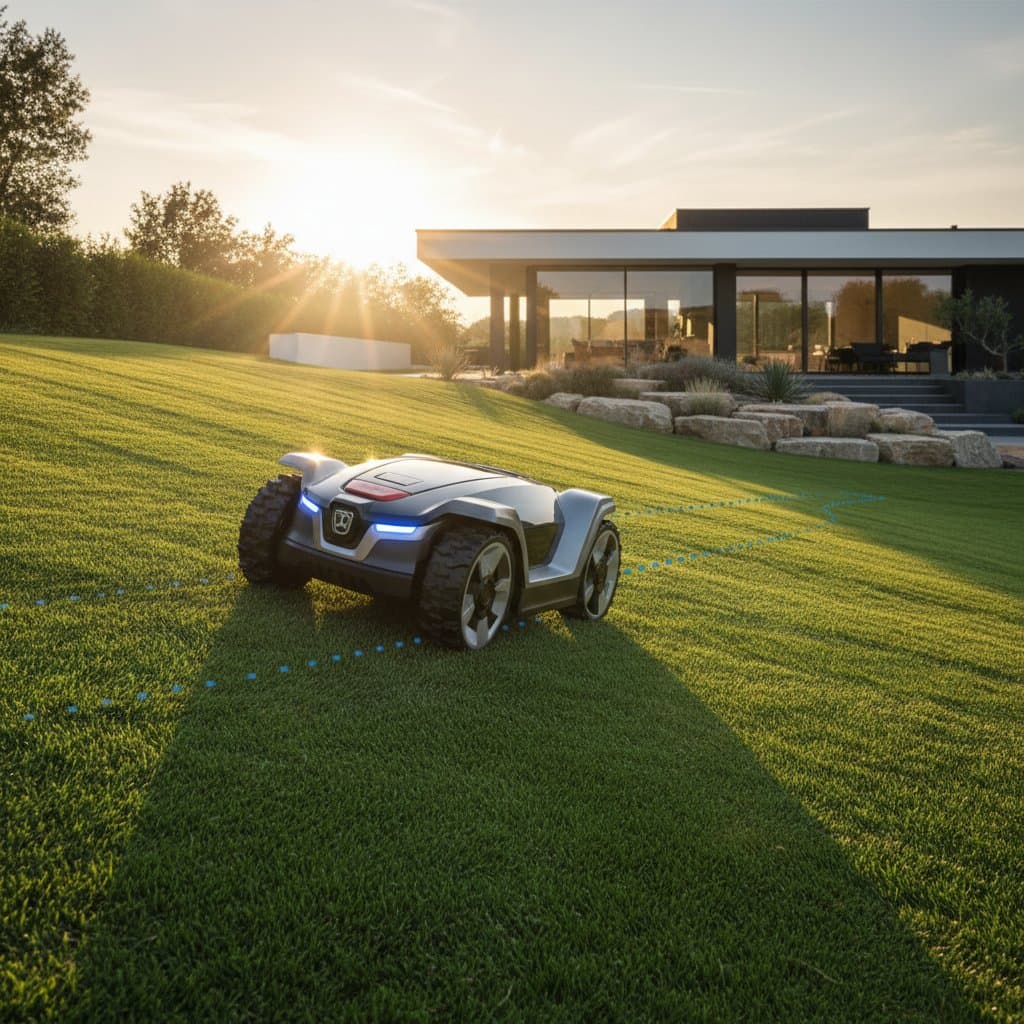
Robotic Mowers Master Challenging Terrain
Rolling lawns enhance curb appeal, yet uneven surfaces turn mowing into a strenuous task. Robotic mowers address this challenge by navigating slopes, roots, and obstacles independently. These devices maintain neat grass through precise cuts and operate with minimal noise. Homeowners and landscapers benefit from reliable performance that requires little oversight.
Key Overview
Suitable Settings: Residential yards and commercial properties
Coverage Area: Small plots to several acres
Adaptability: Functions across various climates with customizable options
Primary Objective: Automated maintenance for difficult landscapes
A properly configured robotic mower outperforms many manual or riding alternatives on irregular ground. It detects elevation shifts, maneuvers past barriers, and delivers uniform trimming on diverse surfaces. Lawns appear freshly maintained daily, free from the labor and clamor of conventional methods.
Select Tires for Optimal Traction
Tire selection influences a robotic mower's ability to secure footing on inclines. Models equipped with aggressive treads excel on steep gradients and wet areas.
Core Advantage: Enhanced grip minimizes slippage and promotes level cuts on hillsides.
Selection Tip: Prioritize units with height-adjustable wheels or durable rubber patterns suited to combined surfaces such as turf and paths.
Practical Illustration: Certain designs incorporate spiked wheels that penetrate yielding earth, whereas others employ broad rubber belts for firmness on shifting substrates.
One technician observes: “Tire configuration rivals blade acuity in importance. Lacking adhesion, the most advanced mower merely glides rather than grooms.”
Visual Element: Broad rubber treads stabilize the unit as it ascends a shadowed slope.
Implement Intelligent Navigation Systems
Contemporary robotic mowers rely on GPS, infrared sensors, or perimeter wires to map routes. Accurate setup enables efficient traversal while dodging hazards.
Core Advantage: Intelligent routing conserves energy and averts impacts with foliage, boulders, or fixtures.
Selection Tip: Establish digital perimeters to isolate regions like recreation zones, edible plots, or ornamental beds.
Practical Illustration: GPS-enabled units recalibrate trajectories upon encountering saturated ground, safeguarding soil integrity and circumventing depressions.
A landscape professional notes: “Effective setup transforms the mower into a dependable partner. After mapping the site, deviations become infrequent.”
Visual Element: The device halts before a rock-lined walkway as detectors register the transition from sod to stone.
Equip with Advanced Obstacle Detection
Protruding roots, border rocks, and patio items frequently impede standard mowers. Robotic variants deploy sonic or contact detectors to identify and evade such features.
Core Advantage: Detection mechanisms shield blades from harm and preserve aesthetic installations.
Selection Tip: Adjust responsiveness to align with site conditions, prompting timely responses without overreactions.
Practical Illustration: Upon registering a elevated root, the mower retreats and redirects seamlessly, leaving a minor patch for manual finishing.
A contracting specialist remarks: “Detectors serve as the mower's vision. Superior terrain interpretation reduces subsequent adjustments.”
Visual Element: The unit swerves gracefully around a patio seat without contacting the supports.
Strategize Boundary Wire Placement
Perimeter wires delineate operational zones and deter incursions into sensitive areas like blooms or access routes. Thoughtful installation facilitates fluid movement.
Core Advantage: Judicious wiring curtails redundant paths and guarantees thorough attention.
Selection Tip: Position wires along gentle arcs instead of abrupt corners to optimize detection accuracy.
Practical Illustration: In landscapes featuring water features, route wires at minimum one foot from margins to avoid mishaps on moist banks.
A servicing authority states: “Perimeter wire arrangement underpins robotic success. Initial precision ensures ongoing clarity for the device.”
Visual Element: A subtle wire directs the mower beside a winding floral border, undisturbed by surrounding cover.
Align Battery Capacity with Site Needs
Power reserves dictate operational duration prior to docking. Expansive or graded properties demand prolonged endurance.
Core Advantage: Extended runtime achieves comprehensive treatment in reduced cycles.
Selection Tip: Evaluate operational hours against recharge intervals relative to overall area for equilibrium.
Practical Illustration: High-performance lithium cells support coverage of a half-acre per cycle, with recharging completed in less than sixty minutes.
A vendor expert comments: “Power advancements occur annually. Select based on topography as well as dimensions.”
Visual Element: The mower returns to base with sufficient reserve following an extended run.
Schedule Routine Blade and Sensor Care
Automation demands periodic attention to sustain efficacy. Keen edges and unobstructed detectors uphold steady output.
Core Advantage: Consistent servicing prolongs durability and fosters uniform grooming.
Selection Tip: Inspect and cleanse the undercarriage post-operation to eliminate debris obstructing components.
Practical Illustration: Blade renewal every several weeks preserves sharpness on robust varieties like Kentucky bluegrass or perennial ryegrass.
Embrace Automated Lawn Solutions
Integrating robotic mowers simplifies terrain management, yielding pristine results with reduced intervention. These systems adapt to unique landscapes, enhancing efficiency and enjoyment. Professionals and residents alike discover sustained value in their quiet, precise operation, transforming maintenance into a seamless routine.