
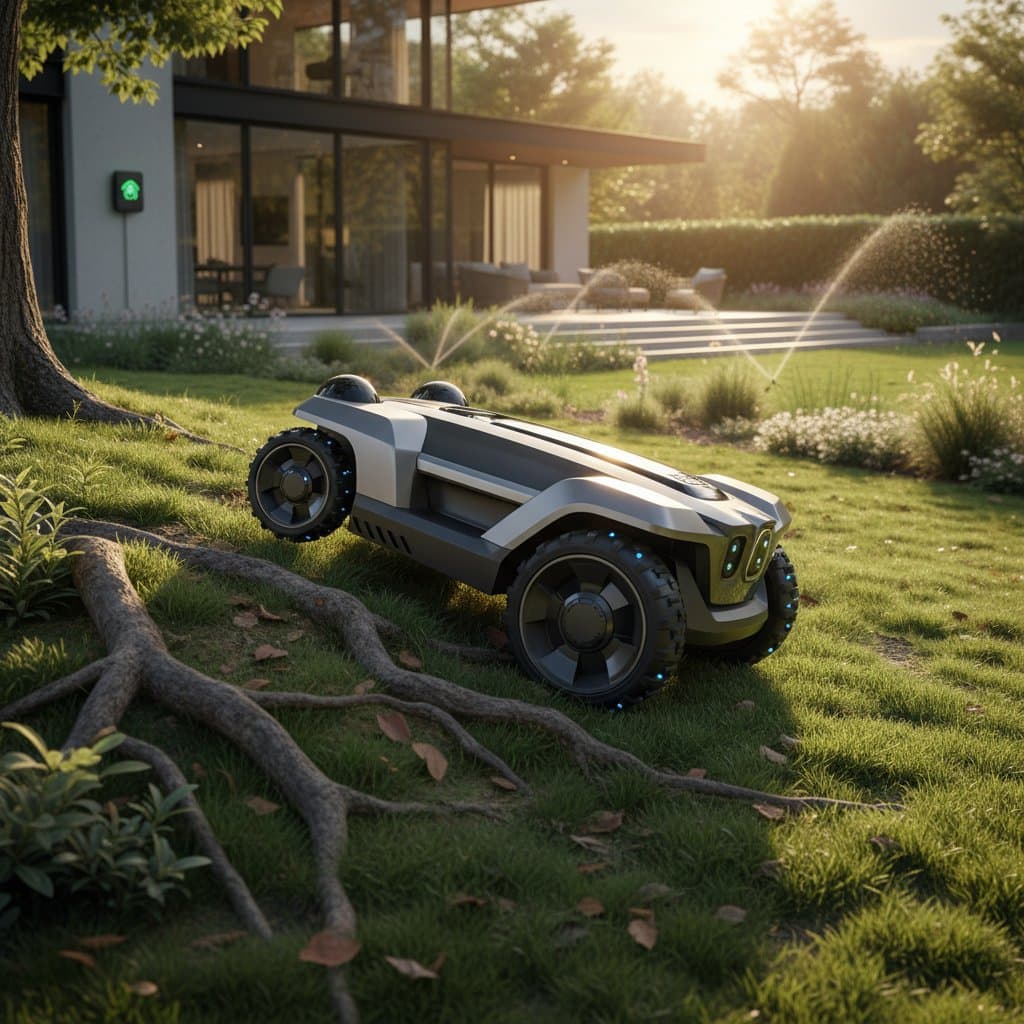
Robotic Mowers Navigate Challenging Terrains with Advanced Technology
The latest robotic mowers transform lawn maintenance for homeowners and landscape professionals facing uneven and complex yards. These devices manage steep slopes, exposed roots, and confined areas with a level of precision previously reserved for manual labor. The outcome includes quieter operations, reduced environmental impact, and uniform results across difficult landscapes.
Advancements in robotics extend beyond flat surfaces to accommodate genuine yard variations. Homeowners benefit from time savings, while professionals achieve consistent standards without constant oversight.
1. Enhance Traction for Steep Slopes
Steep inclines previously demanded hand-held tools or heavy machinery. Modern robotic mowers address gradients up to 40 percent through specialized traction mechanisms. Features such as deep-grooved tires, balanced weight distribution, and real-time speed adjustments ensure stability, even on shifting or damp surfaces.
A landscape technician observes, "The appropriate tire material provides essential grip on wet grass without creating indentations." Units automatically modulate motor power to sustain steady progress uphill and gentle control downhill. Such adaptations minimize uneven cuts and limit ground disturbance.
To maximize performance, combine these traction elements with defined boundaries. Install perimeter wires or utilize GPS-defined virtual boundaries to guide the mower away from flower beds or paved walkways. In steeper zones, introduce low-maintenance plants such as creeping thyme or blue fescue to lessen the need for frequent passes.
Visual Callout: Rubberized tread wheels secure footing on a sloped lawn edged with stone.
2. Overcome Obstacles Using Intelligent Detection
Exposed roots, irregular grass, and decorative elements often disrupted older mower models. Contemporary systems employ sophisticated pattern analysis to differentiate permanent fixtures from movable items. For instance, the software identifies a child's toy or garden hose separately from a fixed tree base.
A landscape engineer notes, "Sensors evaluate surface texture and object density to determine safe navigation routes." This capability safeguards both the equipment and the yard from harm.
Individuals who rearrange patio furniture find this functionality particularly useful. The mower halts momentarily, recalculates its route, and revises the yard map without full interruption. Certain models notify users via mobile applications, detailing path modifications for the session.
Visual Callout: A streamlined mower maneuvers around a raised planter, maintaining proximity to edges without collision.
3. Refine Cutting Strategies for Optimal Results
Initial robotic mowers relied on haphazard routes that produced inconsistent finishes. Updated versions follow structured patterns informed by GPS coordinates. They execute parallel, overlapping strokes akin to those of expert crews.
A turf specialist comments, "This methodical approach conserves power and promotes healthier grass growth." Precise paths preserve blade sharpness, encourage even grass posture, and eliminate unnecessary overlaps that could cause tracks or wear.
Advanced configurations include variable cutting speeds, accelerating through thick, shaded patches and decelerating across exposed sunny expanses. Over repeated cycles, this method yields a more even and vibrant lawn appearance.
Visual Callout: Parallel mowing paths produce a neat, striped pattern across a moderate-sized yard.
4. Strengthen Safety Protocols and Security Measures
Robust safety features now detect elevation changes, tilts, and nearby movements. Upon sensing a lift or overturn, the blades disengage immediately. Geofencing technology secures the unit by immobilizing it outside designated zones, deterring unauthorized removal.
A product specialist explains, "Proximity sensors shield people and animals alike. The mower detects motion and alters course in moments." Infrared scanners spot small creatures or scattered items on the lawn, suspending activity until clearance.
Households with young children or pets appreciate these protections for enabling seamless integration. Access controls, including numeric codes or app-based authentication, restrict operations to approved individuals.
Visual Callout: The mower pauses as a pet traverses the area, resuming after the path clears.
5. Select the Ideal Model for Specific Landscapes
Yard characteristics dictate the most suitable mower selection. Align capabilities with spatial arrangements and local conditions. Smaller units excel in compact urban settings with numerous turns, while robust models with enhanced drive systems suit broad, inclined properties.
A landscape consultant advises, "Choosing a mower parallels selecting irrigation components; compatibility ensures success." In heavy clay soils, emphasize superior traction and height versatility. For loose sandy grounds, opt for lightweight designs that avoid deep impressions.
Whenever feasible, evaluate prototypes through demonstrations. Assess operational noise, application interface efficiency, and transitions between grass and non-turf surfaces. These factors determine enduring reliability and user contentment.
Integrate Robotics for Sustainable Yard Management
Incorporating a robotic mower alters routine outdoor upkeep profoundly. Lawns maintain tidy appearances, borders stay defined, and individuals redirect efforts toward gardening, maintenance, or leisure.
Ongoing innovations promise superior incline management, refined avoidance algorithms, and seamless connections with complementary yard technologies. Success hinges on assessing terrain specifics and selecting tools attuned to those demands.
Robotic solutions elevate lawn care by fostering environmental benefits, curbing emissions, and allowing greater appreciation of personal green spaces.