
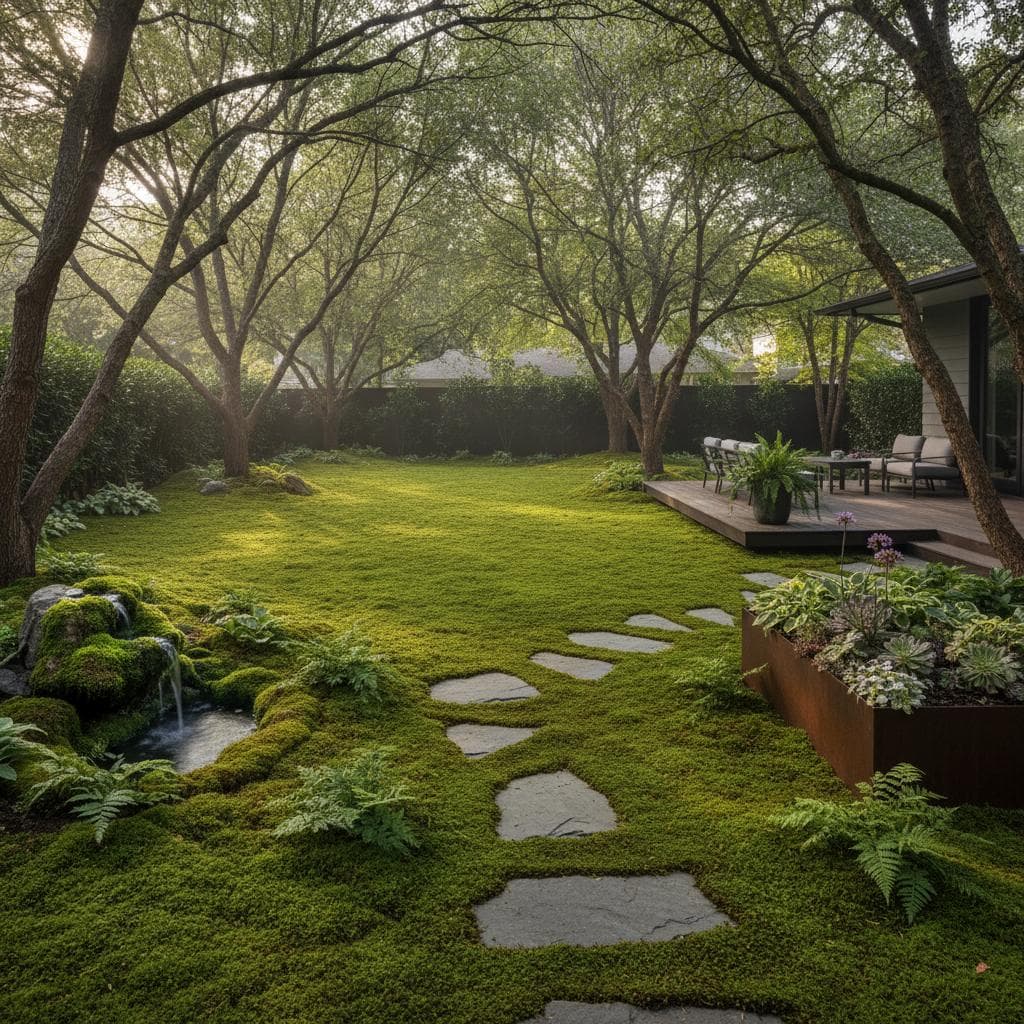
Why Moss Lawns Outperform Grass for Effortless Yard Maintenance
A moss lawn delivers a serene, tactile experience underfoot. It retains its green vitality during dry periods, eliminates the need for mowing, and offers a plush texture that fosters relaxation in outdoor spaces. Homeowners seeking reduced landscape upkeep find moss to be an ideal ground cover, particularly in locations where grass often falters.
Key Considerations
Ideal Locations: Shaded or partially shaded areas
Scalability: Suitable for small patios or expansive lawns
Suitable Climates: Temperate zones with humidity
Primary Objective: Develop a durable, minimal-intervention ground cover to replace turfgrass
1. Eliminate Mowing Entirely
Moss lawns grow in a low, spreading manner that requires no mowing, thereby saving time and eliminating the use of fuel-powered equipment or associated noise. Unlike grass, which expands upward and demands regular trimming, moss maintains a compact height and forms a tidy, cushioned layer.
Landscape professionals note that moss provides a polished appearance without the recurring tasks of cutting and edging. This approach suits homeowners desiring straightforward maintenance while preserving aesthetic appeal. Practically, it reduces the necessity for storing lawn tools. Aesthetically, the unbroken green expanse promotes tranquility, as seen in a front yard featuring moss accented by a stone walkway and border ferns.
Visual Highlight: Moss creates a soft carpet amid stone pavers, tempering rigid lines.
2. Excel in Shaded Environments
Moss thrives in conditions unsuitable for grass, such as beneath tree canopies, along north-facing structures, or in low-light courtyards. It captures available light effectively and draws moisture from ambient air and surface soil, sustaining growth where turf becomes sparse.
Horticulture experts describe moss as an adaptive solution for shaded sites, enabling full utilization of yard potential. Rather than battling to cultivate uneven grass under deciduous trees, integrate moss to complement the existing light patterns, resulting in a vibrant understory.
This adaptation minimizes irrigation and reseeding efforts. It fosters cohesive design by aligning plantings with site specifics, such as combining moss with hostas and Japanese painted ferns in dimmer zones.
Visual Highlight: Moss carpets the shaded soil under established trees, integrating seamlessly with surrounding ferns.
3. Minimize Water Usage
Established moss lawns demand little supplemental water, efficiently capturing and holding humidity from the air or brief rains. Grass, however, evaporates moisture rapidly and requires consistent watering to prevent wilting.
Such efficiency proves valuable in areas with water limits or for those aiming to lower bills. Designers emphasize moss's capacity to retain hydration naturally, akin to a natural reservoir.
Aesthetically, moss imparts a perpetually fresh appearance during arid phases. It complements elements like gravel walkways, stone seating, or fountains, cultivating a harmonious, resource-conscious setting.
Visual Highlight: Moss clings to stones adjacent to a modest fountain, remaining verdant amid dry weather.
4. Avoid Fertilizers and Chemicals
Moss derives essential nutrients from atmospheric deposition and rainfall, obviating the need for fertilizers, herbicides, or pesticides. Grass typically relies on synthetic inputs to achieve uniform vigor and coloration.
This self-sufficiency lessens ecological impact and eliminates storage of hazardous materials. Moss prevents issues like nutrient leaching or unintended chemical exposure. Ecologists highlight how moss yards nurture surrounding habitats rather than disrupt them.
In landscape planning, moss blends effortlessly with indigenous flora, supporting pollinator habitats, woodland borders, and stormwater features without interference. The outcome yields a vibrant, autonomous ecosystem.
Visual Highlight: Moss interweaves with native sedges to form a non-toxic base layer.
5. Maintain Year-Round Greenery
Moss preserves its green shade across seasons, unaffected by extreme heat or cold, unlike grass that fades during stress. Its dependence on moisture ensures rapid recovery following precipitation.
This consistency offers a reliable backdrop without seasonal dormancy. Designers value moss for stabilizing compositions amid fluctuating elements. The subtle hue enhances contrasts with seasonal blooms, timber features, or rock formations, ensuring the yard appears tended year-round.
Visual Highlight: Moss radiates deep green beside leafless trunks under winter sunlight.
6. Prevent Soil Erosion and Compaction
Moss interlocks soil granules into a protective mat, securing inclines and moist banks against washout. Grass roots may falter in dense or thin soils, whereas moss adheres superficially to avert degradation.
Contractors observe moss's reliability in stabilizing terrain where grass erodes. It curbs sediment flow and maintains clean adjacent surfaces post-rainfall. Aesthetically, it preserves organic forms without exposing earth.
In hilly or forested settings, moss safeguards soil integrity with minimal oversight. Its delicate weave pairs well with bolder accents like dwarf mondo grass or liriope, evoking organic balance.
Visual Highlight: Moss sheathes a mild incline, securing earth alongside river rocks.
7. Foster Biodiversity
Moss habitats shelter microfauna, amphibians, and soil organisms drawn to its damp confines. Treated grass areas often lack such vitality due to frequent disturbance.
This nurturing aspect cultivates a self-regulating microhabitat, hosting species like frogs and pollinators within its structure. Ecologists affirm that thriving moss indicates an integrated, dynamic environment.
Designers leverage this vitality to forge nature-attuned spaces, enhanced by layered natives and aquatic elements. Such yards invite mindful engagement over routine labor.
Visual Highlight: Moss mounds collect morning dew, drawing early insects.
8. Provide Subtle Texture and Serenity
Moss introduces nuanced depth and hush to landscapes, muffling sounds and easing transitions from hard surfaces. Its matte finish scatters light softly, contrasting grass's brighter sheen.
Professionals praise moss for infusing contemplative quality into patios or trails. It harmonizes with materials such as slate, basalt, or aged timber, ideal for reflective zones.
Moss unifies varied components, threading through pavers, encasing boulders, or bordering ponds. Even compact areas gain nuance from moss accents in joints.
Visual Highlight: Moss softens a stone bench's perimeter, bridging seat and soil.
9. Achieve Straightforward Establishment
Moss installation involves transplanting colonies, dispersing fragments, or promoting native spread in humid, dim locales, using basic site prep. It adheres to earth, timber, or rock with ease.
Experts indicate that suited moss endures for years with initial care. This longevity curtails replacement needs. Creatively, apply moss to delineate routes, infill stone gaps, or supplant grass for fluid coverage.
Gentle misting and occasional treading accelerate integration. Gradually, it forms a cohesive, regenerative layer, imparting an ageless quality to the space.
Visual Highlight: Transferred moss segments unify across a dim slope with minimal hydration.
10. Align with Sustainable Practices
Moss lawns embody low-resource landscaping trends, forgoing irrigation setups, fuels, and ongoing inputs. This ethos resonates with environmentally conscious residents balancing aesthetics and stewardship.
Sustainability advocates position moss as a understated yet effective choice for simplified yards. It conserves water and emissions while projecting refined naturalism.
Integrate moss with permeable paving, bioswales, and local shrubs for unified, earth-friendly designs that blend intention with authenticity.
Visual Highlight: Moss transitions smoothly into a gravel trail amid native plantings for an integrated, eco-conscious layout.
Maintaining and Appreciating Moss
An established moss lawn requires sparse attention: periodic clearing of litter, tolerance for light passage, and occasional misting in aridity. These steps sustain its vitality across cycles.
Adopting moss often shifts routines toward presence over toil, free from engine clamor or synthetic odors. The space evolves into a haven for repose.
Professionals affirm that self-managing landscapes liberate time for appreciation. Moss fulfills this vision, yielding enduring grace attuned to both daily life and ecological flow.