
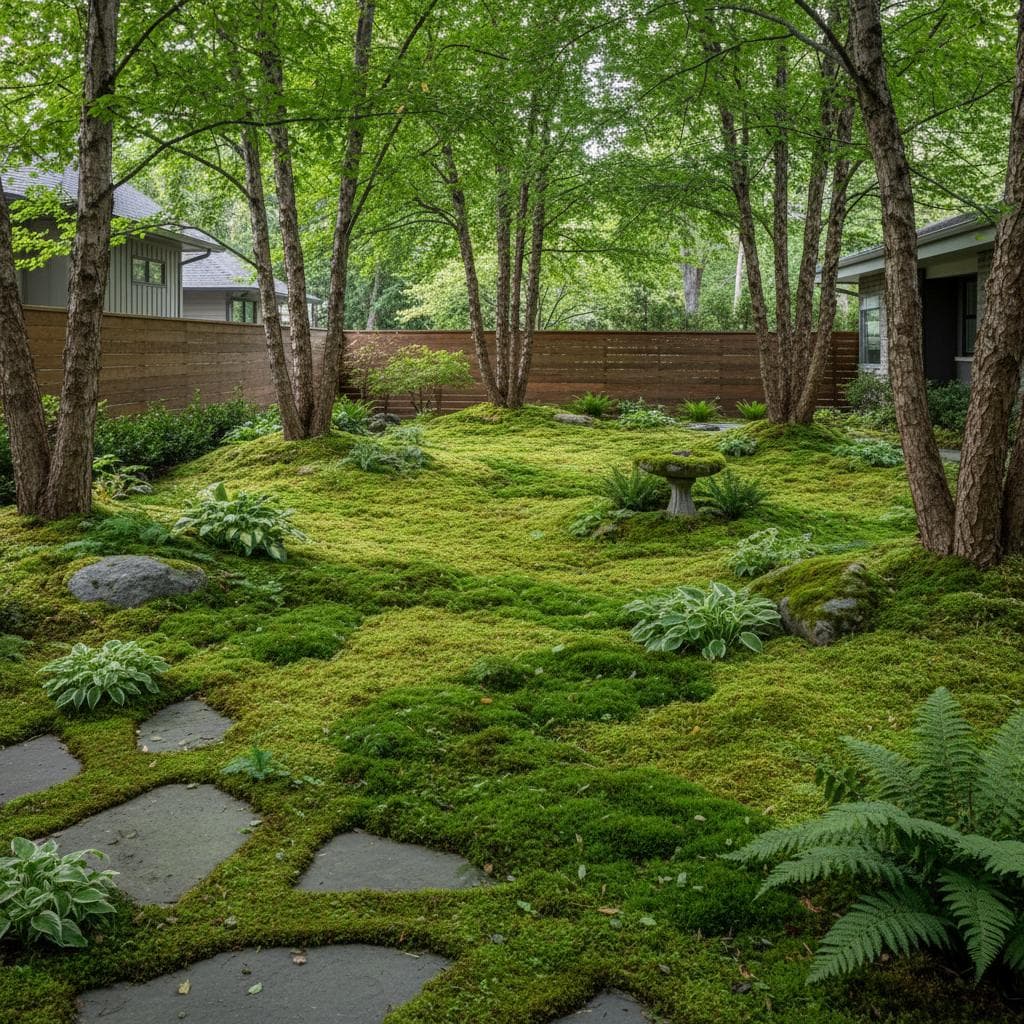
The Appeal of Moss Lawns Over Traditional Turf
Hannah and David selected their wooded suburban home for its peaceful shade and natural charm. The property featured a soft green layer that required no upkeep, revealing itself as moss rather than grass on slopes where turf had always faltered. Rather than resist this feature, they embraced it to develop a durable, evergreen ground cover that avoided the demands of irrigation, cutting, and nutrient applications typical of conventional lawns.
Project Overview
- Homeowners: Hannah, a landscape photographer, and David, a teacher
- Setting: Shaded yard bordered by established oak and pine trees
- Area: About 4,000 square feet of exterior grounds
- Design Firm: Integra Gardens Landscape Studio
- Installation Team: GreenGround Eco Installations
- Objective: Convert uneven grass patches into a resilient, easy-care moss surface
Site Preparation Essentials
The project started with clearing fallen branches and extracting sparse grass remnants. Testing revealed mildly acidic soil conditions, which support moss development. The team avoided deep disturbance and instead used raking to aerate tight spots while adjusting contours for better water flow.
To achieve uniform growth, specialists incorporated pieces from select moss types:
- Sheet moss (Hypnum curvatum): Suited to low-light zones, it spreads into flat, seamless sheets.
- Cushion moss (Leucobryum glaucum): Provides dimensional clumps that reflect light variably across the day.
They applied a light top-dressing of compost mixed with sand to secure the fragments. Regular light spraying over the initial weeks ensured the moss adhered firmly to the substrate.
Effortless Upkeep Routine
Moss lawns stand out for their minimal demands compared to standard turf, which needs frequent trimming, irrigation, and amendments. Established moss requires almost none of these inputs.
Designer Nguyen outlined the approach: "You do not mow it, you do not feed it, and you rarely water it once it is established. The key is keeping debris off the surface so the moss can photosynthesize fully."
The couple now dedicates roughly fifteen minutes every few weeks to brushing away leaves and needles using a soft-bristled tool. In prolonged dry spells, a morning misting session preserves the vivid hue and promotes gradual expansion.
Moss absorbs essential elements from precipitation and airborne particles, eliminating the need for supplements. This practice cuts chemical leaching into nearby streams, benefiting regional habitats.
Textural and Tonal Variety
Moss surfaces offer dynamic patterns beyond solid green. Light exposure reveals shifts from bright jade to subdued olive shades. In dimmer areas, the growth takes on a plush, shadowed depth. Nguyen leveraged these qualities to define gentle transitions.
Adjacent to the seating area, a strip of fern moss (Thuidium delicatulum) introduced delicate fronds that shimmer in available light. Beside walkways, rock cap moss (Dicranum scoparium) filled gaps around pavers, handling occasional steps while contributing upright accents.
Walkways consisted of repurposed granite blocks positioned just above the moss level. This elevation directed excess moisture away and prevented slippery surfaces. The interplay of textured stone against the even moss enhanced the scene's serenity without overwhelming its flow.
Combining Moss with Companion Plants
In mixed-light gardens, moss pairs well with shade-tolerant fillers. Here, the plan included groupings of native ferns, woodland sedges, and hostas along the edges. These selections matched the moss's hydration needs and built vertical interest.
Wild ginger edged the shift to mulched planting zones. Its broad foliage mirrored the moss's organic shapes, maintaining unity.
Nguyen noted, "People think of moss as a filler, but it can be a focal point. It frames other plants beautifully, especially those with bold foliage."
Step-by-Step Installation Guide
Homeowners eager to experiment can begin in modest spots like tree bases or moist borders. Success hinges on matching site traits to moss preferences.
Follow these steps:
- Assess the Site: Confirm acidic pH, adequate drainage, and consistent humidity.
- Clear Thoroughly: Eliminate competing vegetation and litter.
- Scarify Gently: Rake to reveal soil for better adhesion.
- Gather Moss Pieces: Divide salvaged or bought samples into fragments.
- Apply and Secure: Press pieces into the ground and spray daily until rooted.
- Sustain Early Growth: Remove debris and provide light moisture as coverage expands.
For expansive projects, consult experts to select appropriate varieties and sources. Opt for moss from ethical suppliers to safeguard wild populations.
Enduring Harmony in the Landscape
Several months post-installation, the moss covering at Hannah and David's home flourishes steadily. Wildlife activity has increased, and the area promotes relaxation amid daily routines. Maintenance chores like equipment noise or treatment planning have vanished.
The pair now prioritizes leisure in the yard. David shared, "We have more time to actually sit outside. It feels balanced, like the property finally matches the forest around it."
Nguyen emphasized this synergy: "They remind us that not every landscape needs to be controlled. Sometimes the best design works with what nature already wants to do."
Long-Term Resilience and Rewards
Moss coverings evolve gradually, gaining density and strength over time. Thicker mats resist wear and sustain themselves with basic care: spot removal of intruders, surface clearing, and infrequent hydration.
Those transitioning from grass benefit from this deliberate pace. Moss withstands dry conditions more effectively than turf and rebounds swiftly with moisture.
The evolving palette of greens fosters tranquility, encouraging mindful presence. For anyone pursuing sustainable yard solutions, moss delivers reliable function alongside subtle elegance.