
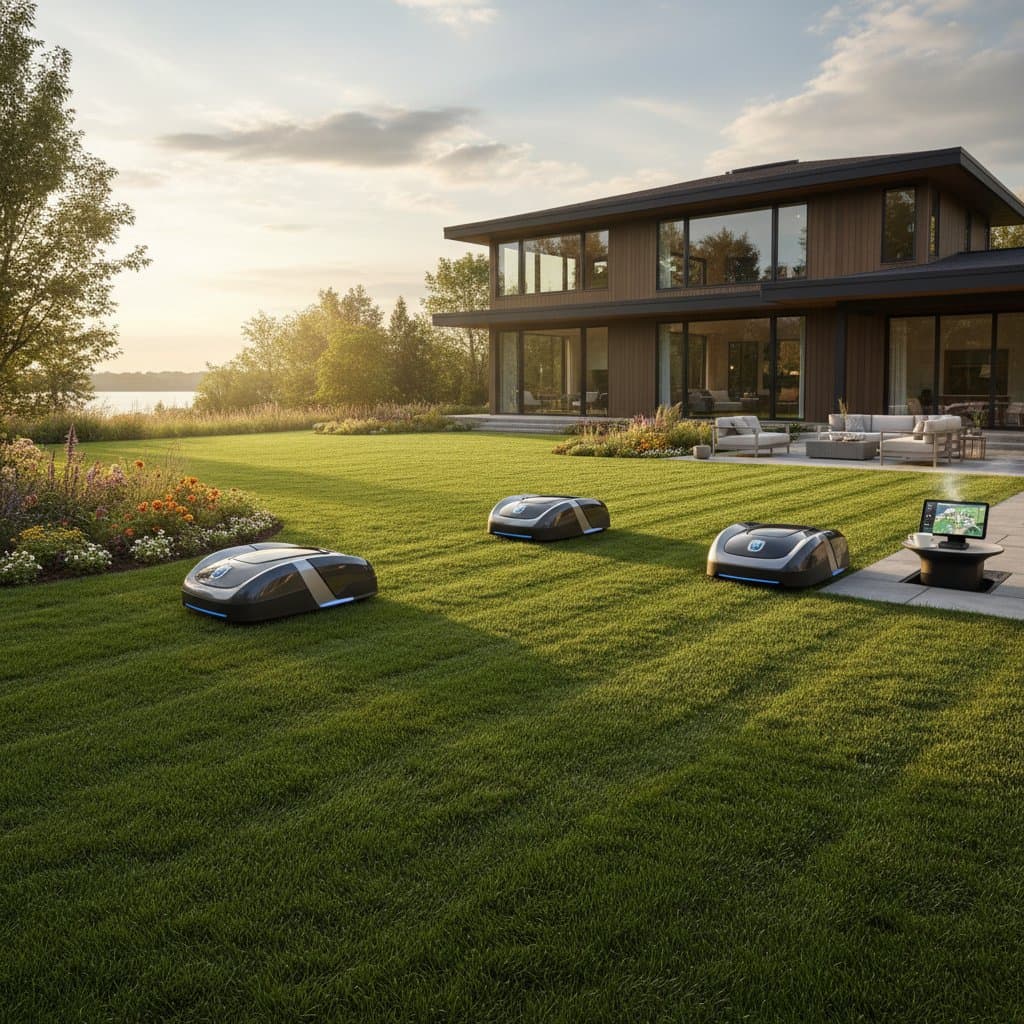
The Reasons Robotic Mowers Are Having Their Breakout Moment
A well-maintained lawn conveys a sense of pride and attention to detail. However, the time-intensive task of mowing discourages many homeowners. Robotic mowers address this challenge by offering quiet, consistent performance that liberates weekends for more enjoyable pursuits. What began as an innovative concept has developed into a dependable solution for everyday landscape management.
At a Glance
- Location: Residential yards and small commercial properties
- Size Range: Compact urban spaces to expansive multi-acre lots
- Climate Zone: Versatile performance in temperate and warm environments
- Project Goal: Minimize manual labor while achieving uniform lawn health
Technological advancements, declining prices, and shifting homeowner preferences converge to position robotic mowers as a mainstream option. This alignment propels the category beyond specialized use into widespread adoption.
1. Advanced Navigation and Obstacle Avoidance
Early robotic mowers struggled with complex yard layouts, often requiring boundary wires for guidance. Current models employ GPS, LiDAR, and AI-driven mapping to navigate freely without physical markers. These systems create virtual boundaries via smartphone apps, allowing users to define no-mow zones around flower beds or pools.
Obstacle detection uses ultrasonic sensors and cameras to identify objects in real time. The mower adjusts its path around toys, furniture, or wildlife, ensuring uninterrupted coverage. For instance, on uneven terrain, multi-wheel designs provide stability, preventing tip-overs on slopes up to 35 degrees.
Homeowners appreciate the precision: blades cut grass to exact heights, promoting even growth. A landscape architect notes, "The mapping technology turns chaotic yards into efficiently managed spaces, reducing wear on the turf."
Visual callout: Smartphone app displays a real-time yard map, highlighting the mower's path around obstacles.
2. Battery Performance Reaches a Practical Peak
Previous battery limitations restricted robotic mowers to small areas, necessitating frequent recharges. Modern lithium-ion batteries extend runtime to eight hours or more, covering up to an acre per session. Intelligent charging stations monitor energy levels and optimize cycles for efficiency.
When the battery depletes, the mower autonomously returns to its base, recharges fully in two to three hours, and continues mowing. This seamless process maintains a regular schedule without intervention. Users report that the system operates reliably through seasonal changes, from spring growth spurts to summer droughts.
The benefits extend to varied landscapes. These mowers handle inclines and shaded sections effectively, delivering consistent results. Environmentally, their all-electric design eliminates fuel consumption, producing zero emissions and operating at noise levels below 60 decibels.
Visual callout: Charging dock positioned discreetly behind landscaping elements, integrating with the garden aesthetic.
3. Affordability and Smart Home Integration
High initial costs once confined robotic mowers to luxury markets. Prices have dropped below $1,000 for entry-level models, with premium versions offering advanced features under $2,500. Financing options and warranties further lower the entry barrier, making them accessible for average households.
Integration with smart home ecosystems enhances usability. Compatibility with platforms like Alexa or Google Home allows voice-activated scheduling or status checks. Apps provide notifications on completion, battery status, or maintenance needs, turning the mower into an extension of home automation.
This connectivity simplifies oversight. For example, users can adjust cutting heights remotely or receive alerts for low grass conditions. A tech reviewer states, "Seamless app control makes it feel like the mower anticipates your needs, blending into daily routines effortlessly."
Visual callout: App interface showing scheduled mowing times synced with weather forecasts.
4. Safety and Reliability Reach New Standards
Safety issues, such as exposed blades posing risks to pets and children, hindered earlier adoption. Contemporary designs incorporate multiple sensors that detect motion and lift, stopping blades within milliseconds of any obstruction. Ultrasonic and infrared detectors create a perimeter bubble, prompting evasive maneuvers.
Rain sensors pause operations during wet weather to avoid slips, while anti-theft features like PIN codes and GPS enable remote shutdowns. These mowers withstand daily exposure, with weatherproof casings and self-cleaning mechanisms that repel debris.
Durability ensures long-term value. Components like brushless motors resist corrosion, and modular blades allow easy replacements. A safety expert comments, "These safeguards exceed manual mower standards, providing peace of mind in active family environments."
Visual callout: Sensor activation halts the mower near a pet, redirecting it safely along the edge.
5. Sleek Design and User-Friendly Setup
Bulky appearances once clashed with yard aesthetics. Newer models feature compact, low-profile builds in neutral colors that blend with surroundings. Weighing under 30 pounds, they maneuver easily without compacting soil.
Installation requires minimal effort: users place the charging station, download an app, and map the yard in under 30 minutes. Customizable schedules adapt to growth patterns, with options for mulching or side-discharge modes.
The intuitive design appeals to non-technical users. Blades adjust automatically for grass type, ensuring optimal health. Gardeners observe, "The modern look and simple setup make it a natural addition to any landscape, not a conspicuous machine."
Visual callout: Streamlined mower gliding along a border, its design echoing contemporary garden tools.
6. Environmental Awareness Drives Adoption
Sustainability concerns influence purchasing decisions, and robotic mowers align perfectly with green initiatives. Electric powertrains cut greenhouse gases, while lightweight frames minimize soil disturbance. Daily light cuts leave clippings on the lawn as natural fertilizer, reducing fertilizer needs by up to 30 percent.
This method fosters healthier turf by preventing stress from infrequent heavy mowing. Biodiversity benefits emerge as well, with precise trimming avoiding overgrowth that harbors pests. Maintenance involves basic tasks like blade sharpening every few months.
A sustainability advocate explains, "By promoting natural decomposition, these mowers enhance ecosystem balance without synthetic aids. They represent practical ecology in action."
Visual callout: Mulched clippings nourishing the grass, visible as a light layer on the vibrant green.
Embracing Automated Lawn Maintenance
Integrating a robotic mower reshapes outdoor experiences. The absence of engine roar creates serene evenings, while consistent grooming keeps yards guest-ready. Time saved allows focus on creative tasks like planting or hosting gatherings.
For professionals, these tools streamline operations, allocating labor to specialized care. This evolution underscores a broader movement toward self-sustaining landscapes that enhance quality of life.
As growth seasons return, the subtle whir of a robotic mower signals progress. It embodies efficient, unobtrusive care that harmonizes with nature and modern living.