
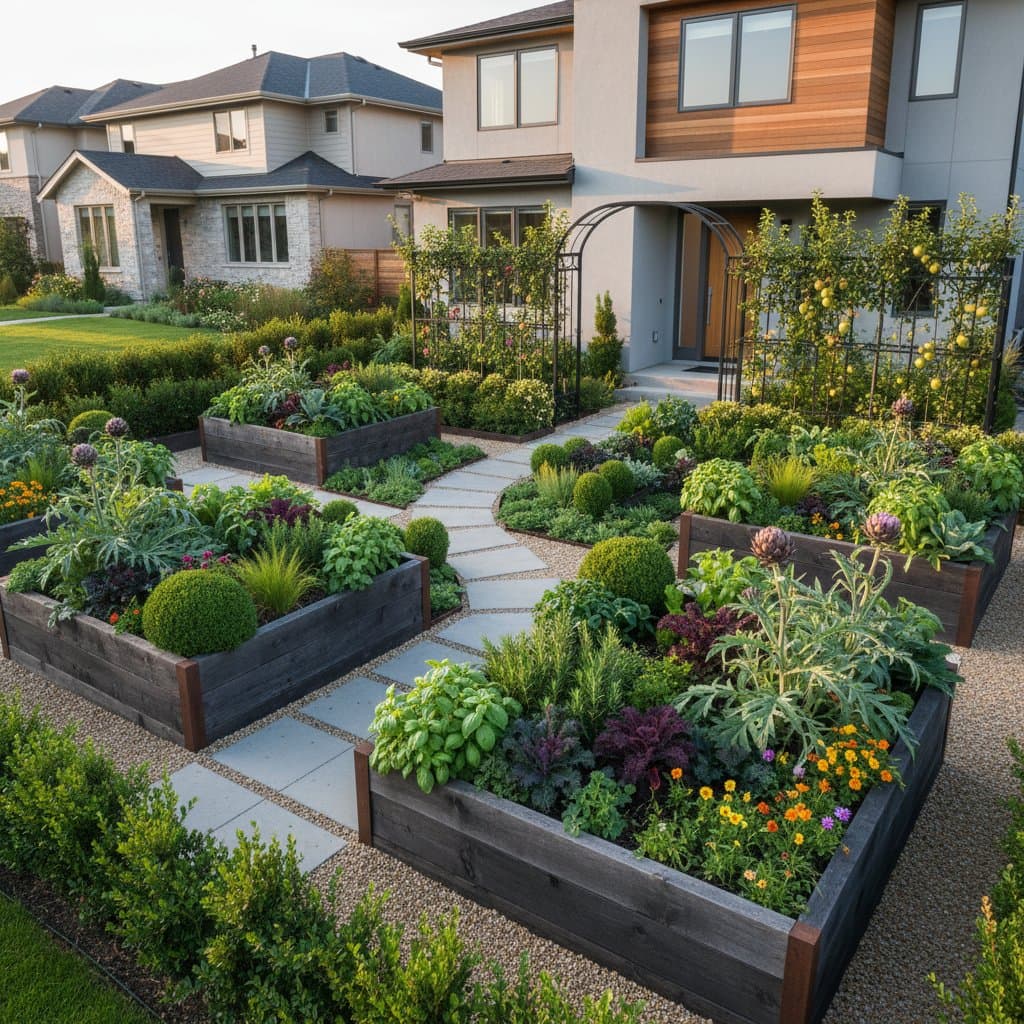
HOA Rules? No Problem for Edible Front Yard Gardens
When Sarah and Michael Torres purchased their suburban home, they envisioned a front yard that nourished their family while satisfying homeowners association standards. Neighbors had faced challenges with restrictions on vegetable gardens, yet the Torres family resolved to craft a design that balanced productivity and aesthetics. Their landscape now integrates herbs, berries, and greens alongside shrubs and flowers, organized for order and visual appeal.
At a Glance
- Who lives here: Sarah and Michael Torres, with their two children
- Location: A planned community in a warm, temperate region
- Size: Approximately 1,800 square feet of front yard space
- Landscape Designer: Jenna Ruiz, Green Current Design Studio
- Contractor: Urban Soil Solutions
- Project Goal: Create an edible garden that reads as decorative, while staying within HOA guidelines
Starting with the Rules
The Torres family examined their HOA landscaping documents thoroughly. The guidelines permitted edible plants but mandated neat appearances, neighborhood consistency, and approved ornamental species. Jenna Ruiz notes, "The key was interpreting those words creatively. We looked for common ground between what the HOA wanted to see and what the homeowners wanted to harvest."
They established structure as the foundation. Raised beds were prohibited, but curved planting borders and low retaining edges gained approval. Layered planting and geometric forms ensured the space appeared traditional rather than utilitarian.
Setting the Framework
A narrow flagstone path connects the driveway to the front door, edged with edible groundcovers in place of grass. Dwarf thyme, creeping oregano, and strawberries occupy the gaps between stones, creating a textured living surface with gentle color variations. Ruiz observes, "We replaced turf with edible texture. It looks intentional, and it performs better in dry weather."
Small mounds along the walkway support blueberries, rosemary, and lavender. These plants maintain tidy shapes, and their foliage harmonizes with nearby shrubs. Taller elements include pomegranate, fig, and dwarf citrus trees, pruned for balanced forms that yield fruit while serving as focal points.
The Entry Zone
The planting near the porch shifts to a formal arrangement. Large ceramic planters bookend the steps, each containing Swiss chard, purple basil, and edible nasturtiums. The varied leaves and vibrant flowers appear ornamental from the street, yet provide kitchen-ready greens. Glazed in muted taupe to match the home's trim, the planters enhance overall cohesion.
Foundation plantings merge edibles and ornamentals. Boxwood hedges form a low border at the porch base. Kale and rainbow chard alternate with sage and marigold, their repeated colors and heights establishing rhythm. Ruiz adds, "We borrowed the formality of classic garden design, but everything here earns its keep."
The Side Strip
The side yard transforms into a compact orchard. Espaliered apple trees align along the fence, supported by stainless steel wires for space efficiency. Comfrey, chives, and calendula grow below, attracting pollinators and controlling weeds. Shredded leaf compost mulch enriches the soil and maintains a dark, uniform surface.
This area stays concealed from view but boosts the harvest significantly.
Material Choices
Selections for visible elements prioritize harmony and durability. Recycled composite boards in warm brown edge the beds, aligning with the mulch and flagstone. Drip irrigation tubing hides beneath the mulch, linked to a smart controller that monitors soil moisture for precise watering. The family sought minimal upkeep over constant tasks.
Low-voltage lighting in matte bronze accents the trees and path, offering a refined nighttime presence. The HOA values the uniform style, and the Torres family appreciates the illumination for evening herb collection.
Seasonal Layers
Ruiz designed for year-round compliance and appeal through crop rotation. Cooler periods feature lettuces, spinach, and peas in the beds. Warmer seasons introduce tomatoes, peppers, and eggplants. Ornamental companions like alyssum, salvia, and echinacea intersperse among them, preventing bare patches during transitions.
Varied textures ensure continuous interest. Sarah remarks, "We learned to treat the vegetable garden like any other decorative planting. We stagger colors, heights, and bloom times. It is not just about what is edible, but how it fits the picture."
Privacy and Screening
To address sightline concerns without tall fences, the design employs edible barriers. Clumping bamboo, specifically Bambusa multiplex ‘Alphonse Karr,’ offers privacy within height limits. Noninvasive and regularly pruned, it controls growth effectively. Pineapple guava hedges in front add thickness and produce fruit.
These layers enclose the side patio while preserving an open, neat facade. The arrangement fosters seclusion that remains welcoming to neighbors.
The Edible Aesthetic
Repetition and restraint define the approach. Ruiz selected about twenty edible plants for their dual roles in yield and appearance. Considerations included leaf color, fruit shades, and growth patterns. Silver herbs reflect the house's gray tones, while red lettuces and peppers introduce contrast.
Key plant selections include:
- Trees: Dwarf Meyer lemon, compact fig, pomegranate
- Shrubs: Blueberry, pineapple guava, rosemary
- Perennials: Thyme, oregano, sage, lavender
- Annuals: Kale, Swiss chard, nasturtium, edible marigold
- Groundcovers: Strawberry, creeping thyme, sweet alyssum
This limited palette promotes unity and diverse harvests. Ruiz emphasizes, "It is about restraint. Too many colors or textures can look chaotic, which is what HOAs fear. We used repetition to make abundance look orderly."
Soil and Sustainability
Robust soil supports the design's success. The contractor improved the clay soil with composted manure and coconut coir for better drainage. Organic mulch tops the beds to conserve water and deter weeds. Worm castings and fish emulsion provide nutrients without synthetics.
A rain barrel near the garage captures roof runoff, supplying the drip system during droughts. Positioned out of sight, it complies with utility restrictions. This method cuts water bills and bolsters long-term soil vitality.
Harvest and Daily Use
The front yard delivers consistent produce despite its ornamental style. Herbs come daily, fruits weekly, and greens on demand. The children gather strawberries from the path each morning. Guests inquire about the borders, often startled to discover their edibility.
Michael shares, "People assume it is just landscaping until they see us cooking from it. Then they start asking how they can do the same without breaking their HOA rules."
Working with the HOA
The family disclosed their plans upfront, submitting a detailed planting scheme to the review board. Ruiz included labeled images and projected mature sizes to demonstrate neatness and proportion. The board approved promptly, citing alignment with community standards.
Neighbors soon followed suit, and the HOA now endorses the design as a sustainable example.
Integrating Design into Daily Life
The garden serves as a resource and social hub. The family hosts dinners along the entry path, enveloped in scents and hues from the plants. Upkeep includes pruning, replanting, and soil assessments, eased by the irrigation and mulch.
Sarah concludes, "We wanted to prove that you do not need to hide your food plants in the backyard. You just need to treat them with the same design respect as any ornamental garden."
Homeowners facing HOA constraints can apply these principles: review guidelines first, then build structure with repetition and strategic plants. Prioritize form to accommodate function, turning restrictions into refined, fruitful spaces.